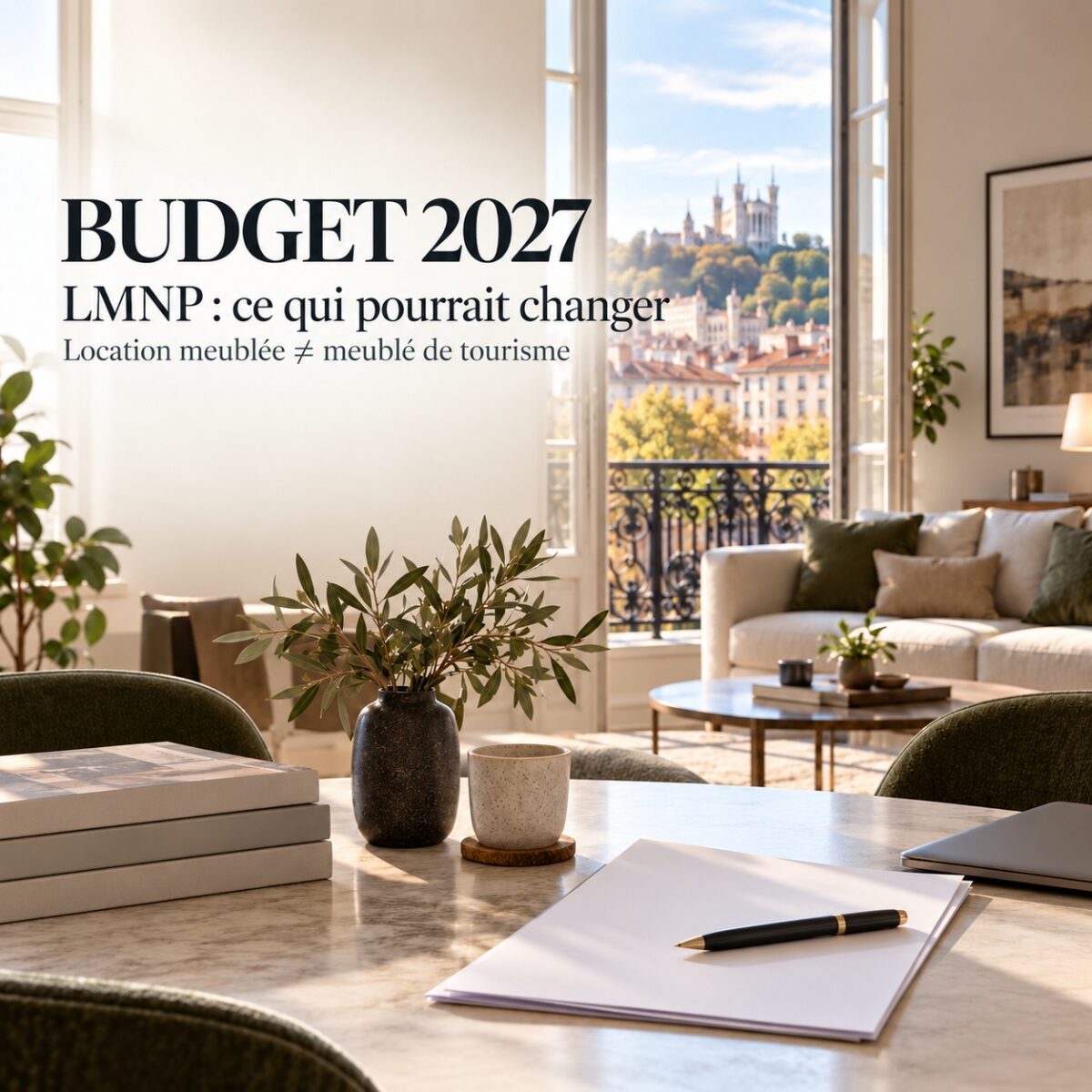
France’s 2027 budget proposal: what could change for LMNP landlords?
France’s 2027 budget proposal: what could change for LMNP landlords?
The draft proposes limits on the tax deduction for depreciation. It sets different thresholds for ordinary furnished lettings and for properties that fall under the legal definition of furnished holiday accommodation.
At this stage, a clarification is essential: these measures are not yet in force
The bill has been submitted to the National Assembly. It must now go through the entire parliamentary process and could therefore be amended, substantially modified, or have certain provisions removed.
It remains interesting for a landlord to understand the proposed direction now.
LMNP: why is depreciation so important?
When the owner of a furnished property is subject to the actual expenses tax regime, they can account for various costs related to their activity.
They can also record depreciation on the property and certain items of equipment.
The aim is to take into account the theoretical depreciation of the property and its components over time.
This depreciation can reduce the taxable income from the rental and thus represents one of the key elements of the LMNP actual expenses regime.
The 2027 finance bill proposes to modify this mechanism.
What the 2027 Budget proposal envisages for LMNP
Under Article 7 of the draft submitted on 1 October 2026, a non-professional furnished landlord would be able to deduct depreciation on the property up to the following limit:
2.5% of its value and a maximum of 7,000 € per year and per fiscal household.
This is therefore a dual cap: a maximum rate and an annual maximum amount.
The impact would depend on the property’s value, how it is financed, the owner’s other expenses and the depreciation currently claimed.
Each situation will therefore need to be individually assessed with the tax or accounting professional responsible for the landlord’s affairs.
A lower ceiling for furnished tourism properties
The proposal introduces a distinction that deserves highlighting
For a property that meets the legal definition of a furnished holiday rental, the proposed ceiling would fall to:
1.5% and a maximum of 5,000 € per year and per fiscal household.
The proposal would therefore distinguish between ordinary LMNP lettings and furnished holiday rentals for tax purposes.
This matters because French law has a specific definition of furnished holiday accommodation.
It is therefore not sufficient to consider that a rental is ‘short’ or ‘medium-term’ to automatically determine its treatment
The duration of stay, the property’s location, the type of contract and its use must all be taken into account
What would happen to depreciation carried forward?
The 2027 Budget proposal does not only concern future depreciation charges
It would also change how landlords use depreciation that could not be deducted in earlier years and has been carried forward.
The proposal would limit the future use of depreciation that remained undeducted in accounting periods ending before 1 January 2027.
It could be set against up to half the taxable profit remaining after depreciation for the year, for a maximum of ten years.
For owners with a substantial balance of depreciation carried forward, this provision could matter as much as the new annual ceiling.
A measure that fits within a broader evolution of the furnished property tax regime
This proposal is not an isolated development
Over the past few years, several texts have already modified the fiscal or regulatory environment for furnished rentals
In its explanation of the 2027 budget, the government said it wanted to bring the tax treatment of unfurnished lettings and LMNP closer together while encouraging longer-term rentals.
The proposal clearly distinguishes between classic furnished rental and tourist furnished rental.
This confirms a trend that landlords must now incorporate: furnished rental is no longer a single model.
Furnished rental and tourist furnished rental: two concepts not to be confused
In common usage, furnished rental is still frequently equated with Airbnb or tourist rental.
The reality is much broader.
A furnished property can accommodate:
- a traveller for a few nights;
- an employee on a work assignment lasting several weeks
- a professional on mobility;
- a student;
- a person in training;
- a family between two homes;
- a tenant temporarily seeking an apartment before final relocation.
These situations correspond to different needs and may fall under distinct contractual and regulatory frameworks.
It is therefore essential not to reason solely based on the duration of the stay.
For a landlord, the question becomes that of the right mode of operation
For a long time, a landlord’s reflection could mainly focus on the rental rate or the expected return
Today, several parameters must be studied simultaneously:
- the applicable housing regulations;
- its location;
- the landlord’s status;
- taxation;
- real rental demand;
- the medium-term stay duration;
- management constraints;
- and the landlord’s asset objectives.
An apartment located in central Lyon does not necessarily need to be operated in the same way as another furnished property simply because both are furnished.
The right letting strategy depends on the property, the rules that apply to it and the owner’s plans.
The medium-term duration is gaining increasing importance
This evolution is particularly interesting for properties intended for temporary mobility.
Between short-term tourist rentals and traditional tenancy, there is a significant demand for fully furnished and equipped apartments available for several weeks or months.
Professional mobility, temporary assignments, training, job transfers, work in a primary residence, or transitional periods create needs that do not align either with hotels or traditional tenancy
Medium-term furnished lettings of this kind are playing an increasingly important part in 2BeApart’s work in Lyon.
It obviously does not represent a universal fiscal solution: each situation must be assessed according to its legal and fiscal qualification.
But it illustrates why it is becoming less relevant to speak of ‘furnished rental’ as a homogeneous market.
Should LMNP landlords modify their strategy now?
Not yet.
The 2027 finance bill project was submitted on 1st October and has only just begun its parliamentary journey.
The limits of 2.5% and €7,000, and 1.5% and €5,000 for furnished holiday rentals, were contained in the proposal. At the date of the article, they had not been enacted.
It is advisable to wait for parliamentary debates and the final text before drawing precise fiscal conclusions.
Nevertheless, property owners can already reflect on the overall coherence of their rental strategy.
With 2BeApart: adapt the model to the property rather than the property to the model
In Lyon, the rules for furnished rentals have become complex enough that owners also need to consider how a property can be let over time, beyond its highest possible short-term return.
With 2BeApart, we prefer a different approach: analyse the property, its location, the applicable regulatory framework, and the demand that it may meet.
Depending on the property, this may lead to prioritising short-term, medium-term, long-term stays, or a combination tailored to different mobility needs.
The objective remains the same: build a coherent and sustainable operation for the owner, rather than applying the same revenue model to all apartments.
The parliamentary journey of the 2027 Budget must now be closely followed.
We will return to these provisions once their drafting has evolved or when the final text is known.
This article describes the main provisions of the bill as tabled on 1 October 2026. For advice on your own circumstances, consult a qualified accountant or tax adviser.
Primary source: French National Assembly, Finance Bill for 2027, No. 3210, Article 7, tabled on 1 October 2026.